Lesson:#
1. Tell your partner about your HSM review#
2. Review Project#
ConceptScriptStoryboard- Final images
- Photo to film editor.
- Record audio
3. Review film making#
Shots 1#
Shots 2#
Rule of thirds#
Storyboards#
- review conventions
4. Review shots with language of:#
- composition
- draw attention to thirds.
- body language and facial expression
5. Review ‘show don’t tell’ principle.#
How can you show
- the passing of time?
- a character is thinking
- a character is lonely
- a character is angry
- a situation is dangerous
- where a scene is happening Examples from HSM and SOM
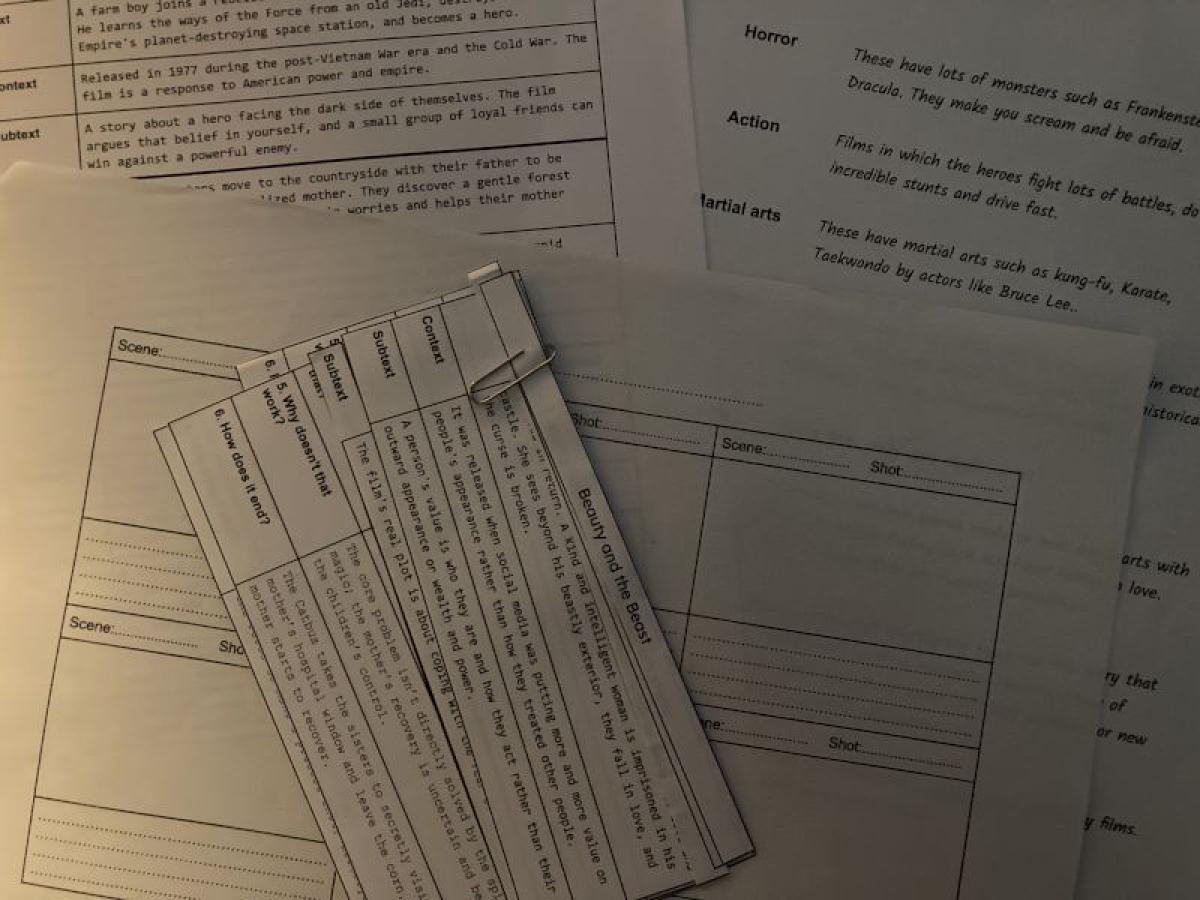
Film makers take a written script and transform it into a film where they tell the story visually. Whereas in a novel the story is told, in film the story is shown. The way we plan how we will make the film visually is through storyboarding. We use storyboards to think of ideas and communicate them with members of the crew. We therefore need to be able to talk about our storyboards.
- Use examples of shots from HSM1
- body language and facial expression.
- passing time
- establishing shots
- scale of figure
Review body language#
Review shots and visual story telling#
Learn about the 🔗 Rule of thirds#
6. Learn about 🔗 Storyboards#
Watch this video and answer these questions.#
- Why do film makers make storyboards?
- What information can be shown in storyboards?
- How do artists show movement in storyboards?
7. Start your storyboard#
Storyboard PDF#
Storyboard answers#
Why do film makers make storyboards?#
- To see (vizualise) how the film will look. To choose shots and composition.
What information can be shown in storyboards?#
- Storyboards are used to choose shots and composition.
How do artists show movement in storyboards?#
- Artists use arrows to show movement.
Key points#
- There are no strict rules to drawing a storyboard but it must show information clearly.
- Storyboards are used to choose shots and composition.
- The director and illustrator create the storyboard. Sometimes also the cinematographer and production designer.
- Storyboards contain:
- Panels which shows the picture of the shot. These must be written in the correct aspect ratio.
- Panels are labelled with the shot number and notes.
- Arrows in the panels show:
- camera movement
- character movement
- Composition
- Camera angle
- Lighting
- Colour
Homework:#
- Continue your storyboards.